


Rediscovering Polaroid Type 42

Last autumn my camera technician friend Jeff Shepherd sent me a couple rolls of Polaroid Type 42, a variety of the original roll-based instant film used in the earliest Polaroid cameras. Although decades past its nominal expiration, this film had somehow survived well enough to still have a chance of producing images. Jeff thought I might like to try it in my Model 95 Land Camera, an item I’d collected purely for its historical significance.
Polaroid’s Model 95, the first instant camera ever brought to market, went on sale at the Boston department store Jordan Marsh on November 26, 1948. Edwin Land’s initial public demonstration of the new instant photographic process had made sizable waves the year before, and the Model 95 met enthusiastic demand from an excited and curious public. A variety of updated and upgraded cameras followed it in subsequent years.

The Model 95 and its progeny used the same series of 3¼ x 4¼” film rolls. Incredibly, before the company built custom-engineered machinery to manufacture it, the earliest batches were assembled by hand in perfect darkness by a corps of women workers known internally as the Film Ladies. The very first of these films, Type 40, was an orthochromatic process that produced sepia prints. A few years later, black-and-white panchromatic film like the ISO 200 Type 42 became standard. Through the ‘50s and early ‘60s Polaroid also introduced record-breaking ultra-high-speed roll films, and even a color type. Despite the advent of pack film in 1963 and SX-70 integral film in 1972, Polaroid continued producing 40-series roll films all the way until 1992.
The film I’d received was missing its expiration date stamp, but appeared to have been made in the late ‘80s. Jeff had shown me scans of pictures he’d gotten out of the stuff, so I at least had a reasonable expectation it might do something—but that expectation was not very high.
I checked my camera’s bellows for holes (none, surprisingly) and pored through the dusty manual (mine was made sometime before the updated Model 95A appeared in 1954). After fumbling through the relatively convoluted process of loading the film’s dual spools of negative and positive material, I set up a simple scene in some sunlight. With the Model 95’s special little selenium photometer I obtained a supposedly correct ‘Exposure Number,’ measured the distance for focus, and pressed the lever of the rather anticlimactic shutter. Then I hauled the film’s protruding lead tab out of the camera, bringing together the corresponding frames of exposed negative and receiver sheet and squeezing them through the camera’s steel rollers to start development of the first picture.
More than slightly skeptical, I counted the seconds, then opened the camera’s back panel and picked at the positive’s perforated tab, prepared to peel away only a dry, blank dud. Instead, to my joyous amazement, I found the ancient developer goo had spread fully and evenly across the frame, and retained enough chemical vitality to work the magic of the Polaroid-Land process. Contrary to all reasonable expectation, I had made a picture.
Naturally, I at once set about trying to take one of my cat.
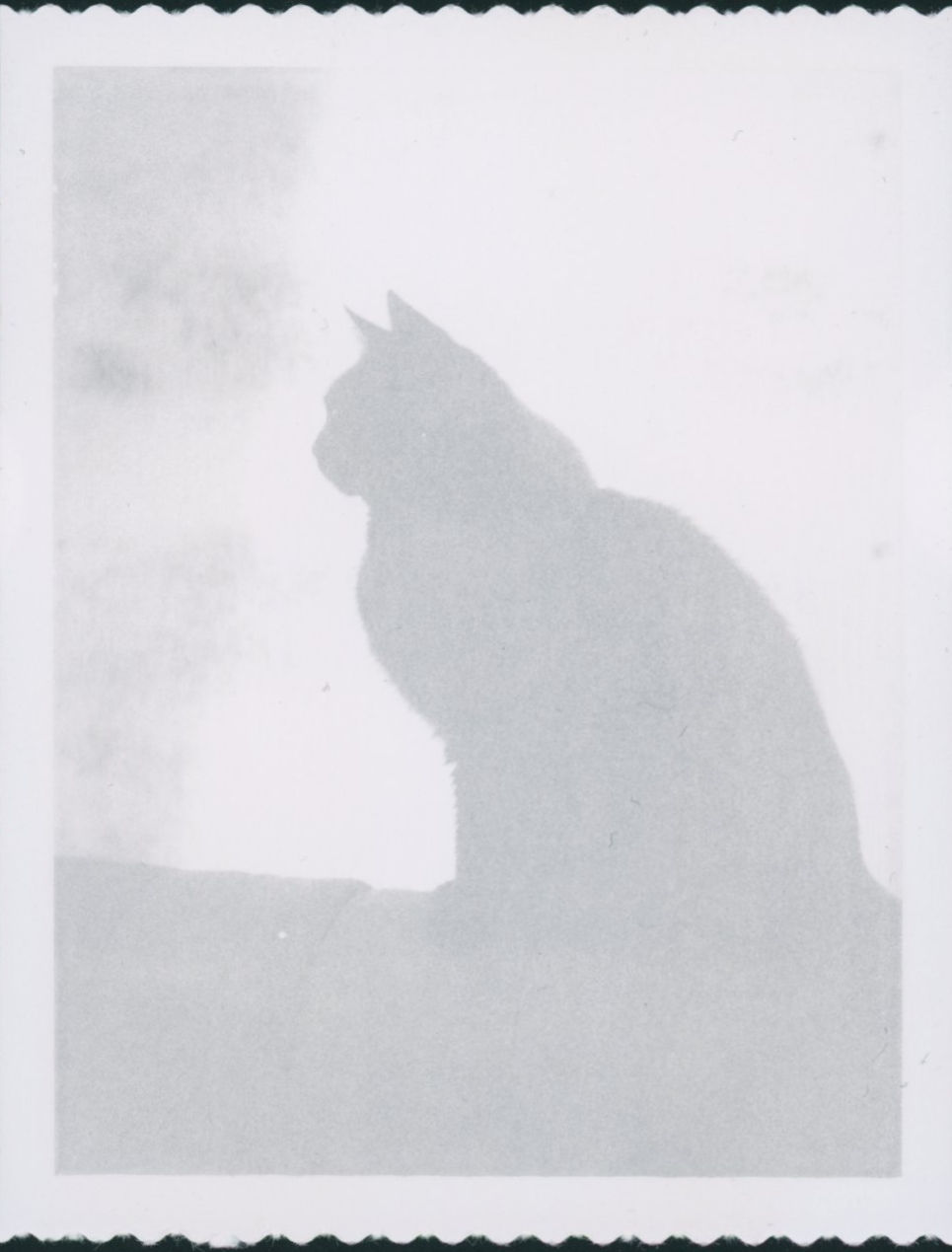
By the time I drew forth the last of the roll’s eight pictures, I was well on my way down this unexpected and unsought turning of the instant photography rabbithole. No new roll film had been made for almost 35 years, but if this roll of Type 42 had lasted all this time, I thought, perhaps some more had as well. And indeed, despite entropy’s relentless best efforts, it turned out some had. I got hold of a few more rolls for myself, and began thinking how I might initiate others into the mysteries of this ancestral instant film process (and its sacrament of vinegary-smelling print coater).
While all this was going on, I’d been in the midst of induction into the august company of the Instant Film Society’s board. No sooner was I installed as East Coast Regional Director than I drew my first breath of rarified air in that lofty position to request a budget appropriation for the purpose of acquiring a stock of Type 42 on IFS’ behalf. Happily, the board concurred it was worthwhile to supply ourselves so we’d be able to demonstrate the operation of the first instant camera and the earliest incarnation of instant photography for some time. Even more happily, I discovered my refrigerator could accommodate the dimensions of an entire case of 40-series film (just barely). I’m grateful to my IFS colleagues for supporting this educational initiative, and for entrusting me with custodianship of its improbable film supply.
At time of writing, I’ve conducted delightfully successful demonstrations of the Model 95 using this Type 42 film at PolaCon Bay Area 2026 and twice at Brooklyn Film Camera. I look forward to making this presentation a regular feature of PolaCon programming as well as a recurring item in BFC’s Historical Film Workshop series, which will raise funds to support IFS operations.

Participants are drawn in by the sheer curiosity of the presentation, and of course the anticipatory excitement of the peel-apart experience, magnified by the fact we’re using film older than most of those in attendance. However, more than this, these demonstrations let people witness and touch an extinct process of crucial importance not only as the first form of instant photography, but as a profoundly significant development in the history of photography broadly. I’m deeply gratified and honored to share this experience with others, be they fellow hardened instant film fiends or complete newcomers to the wonders of the goo.
Now wait till I tell you about the ISO 3000 Type 47 film and the fully manual Soviet clone of the Model 95…


Comments